
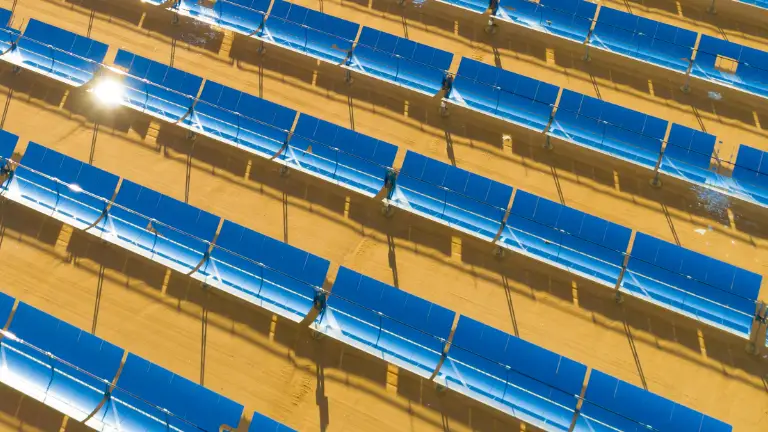
Concentrated Solar Power (CSP) plants generate electricity by concentrating direct normal irradiance (DNI) to produce high-temperature heat, which is then converted to power in a conventional thermodynamic cycle. The main CSP configurations are parabolic trough, central receiver, and Linear Fresnel systems. Unlike photovoltaic systems, CSP can incorporate thermal energy storage, allowing solar energy collection and electricity generation to be decoupled. This enables more dispatchable operation, better alignment with demand, and improved grid integration.
With IPSE, engineers can model complete CSP plants, from solar field and heat transfer loop to storage and power block, using consistent heat and mass balances under realistic boundary conditions. The model can be used to compare trough and tower concepts, evaluate storage options, perform sizing studies, and analyze operating strategies, helping optimize performance and reduce the cost of delivered electricity. Thanks to its unified framework, modlling of CSP plans is available both in the desktop software IPSEpro and the web-based service IPSE GO.
Request Demo Try online (IPSE GO)
Concentrating Solar Power Plant
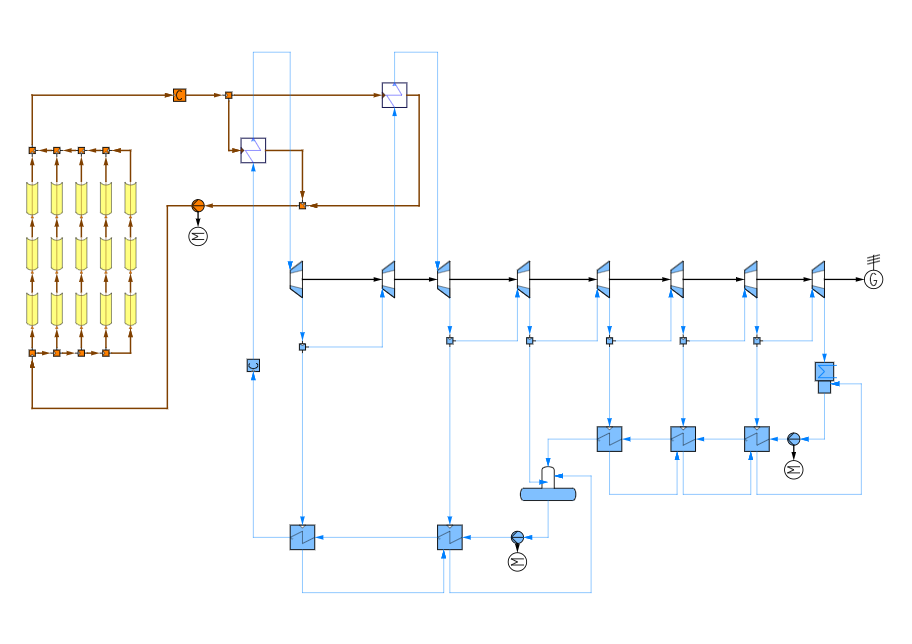
Model of a Concentrating Solar Power Plant with Parabolic Trough Solar Field
Concentrating Solar Power Plant
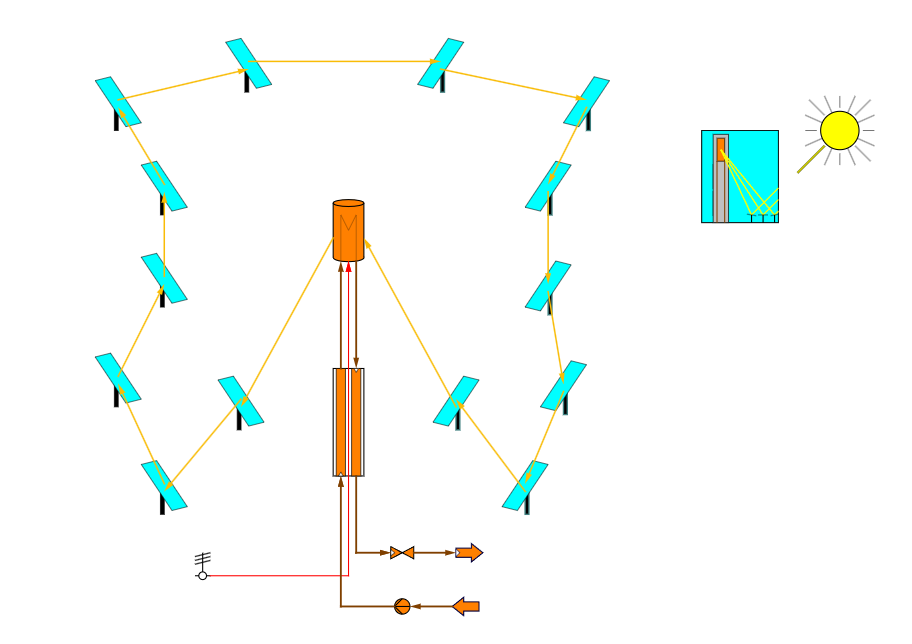
Model of a Concentrating Solar Power Plant with Parabolic Trough Solar Field
Several concepts for CSP plants are in use.
Parabolic trough plants
In parabolic trough plants that focus sunlight onto a receiver tube carrying a heat transfer fluid, providing reliable operation and mature supply chains.
Solar tower (central receiver) plants
Solar tower (central receiver) plants that use a field of heliostats to concentrate sunlight onto a receiver, enabling higher temperatures and potentially higher cycle efficiency.
Linear Fresnel systems
Linear Fresnel systems serve as a cost-focused alternative with simpler collector geometry.
Why accurate performance modelling matters
To compete commercially—especially against increasingly cost-effective PV—CSP plants must be optimally designed and operated. Performance is shaped by both component-level behavior and system integration, including:
- Collector field optical performance and thermal losses
- Heat transfer fluid selection and operating temperature limits
- Thermal storage sizing, charging/discharging strategies, and efficiency
- Heat exchanger and steam generator design (pinch points, approach temperatures)
- Power block performance across varying ambient conditions and part load
- Dispatch strategy under time-varying solar input, electricity prices, and grid constraints
Reliable models are essential to quantify annual energy yield, determine design-point assumptions, evaluate storage value, and identify the best trade-offs between CAPEX, efficiency, and operational flexibility.