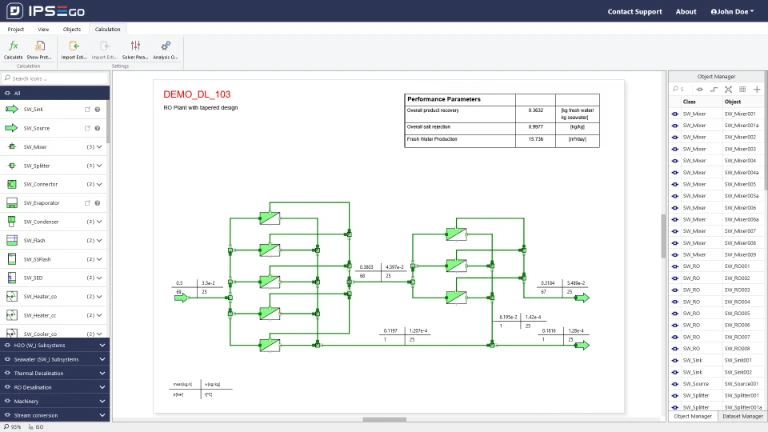
Desalination Plant Simulation Software
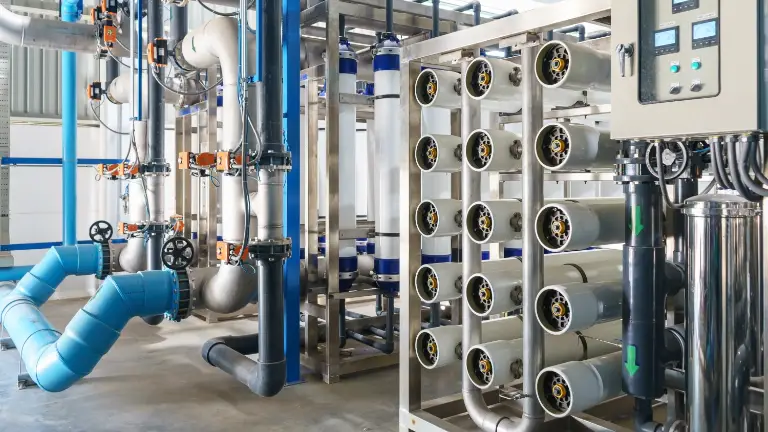 Shortage of fresh water has become one of the major challenges for societies all over the world. Water desalination offers an opportunity to significantly increase the freshwater supply for drinking, industrial use and irrigation. Over the last decades seawater desalination has become an important source for potable water for many arid regions.
SimTech’s Integrated Process Simulation Environment, IPSE, enables engineers to rapidly build robust desalination process models, evaluate plant performance, and to compare technology and design options. Whether for reverse osmosis with pre- and post treatment or thermal desalination processes such as MSF, MED, MVC, and TVC, IPSE supports modelling plants of all desalination technologies with a transparent and flexible modelling approach. Thanks to its unified framework, these capabilities are available both in the desktop software IPSEpro and in the web-based service IPSE GO.
Examples of Desalination Systems Modelled using IPSE
Reverse Osmosis (RO) Plant
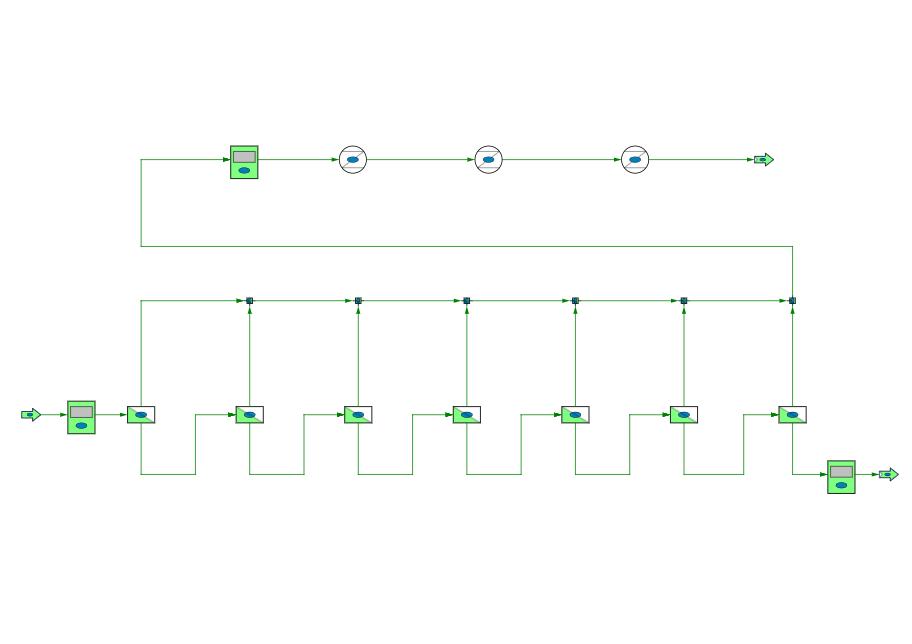
Reverse osmosis (RO) desalination is a pressure-driven process in which feedwater is pressurized and passed across a semi-permeable membrane that lets water pass while retaining most dissolved salts. It produces a low-salinity product stream (permeate) and a concentrated reject stream (brine).
Pressure Recovery System
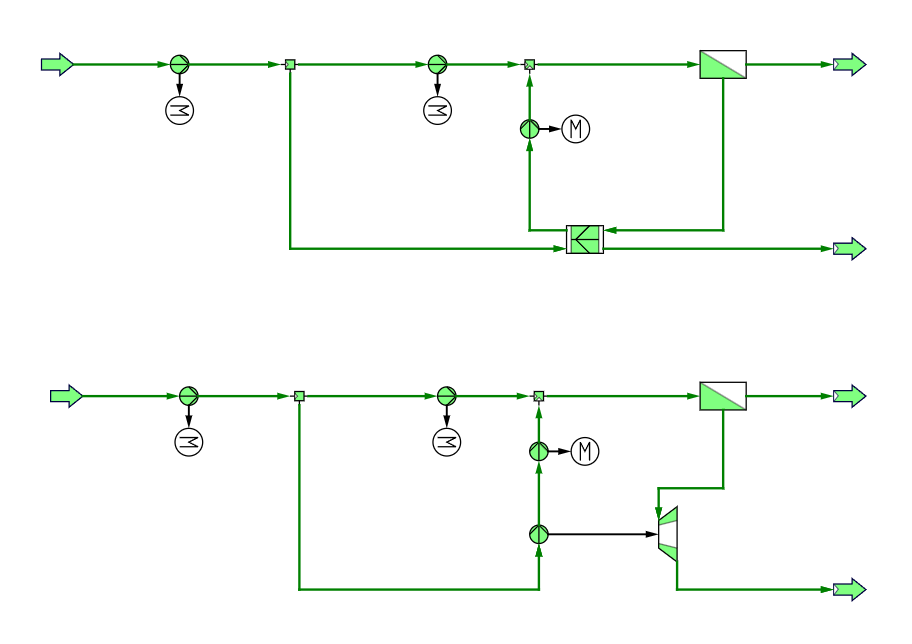
Pressure recovery systems in RO plants reduce energy consumption by recovering pressure from the high-pressure brine stream and transferring it to the incoming feed water. This lowers the load on the high-pressure pump, improves overall plant efficiency, and significantly reduces operating costs.
Multi-Stage Flash (MSF) Plant
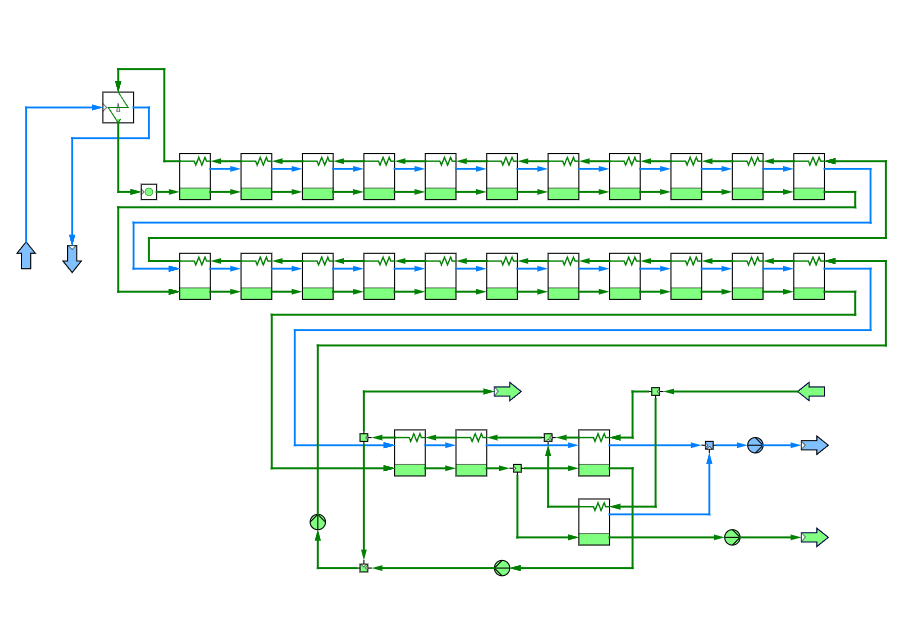
In MSF plants, seawater is heated to a high top brine temperature and then passed through a series of stages at successively lower pressures. In each stage, the pressure drop causes a small portion of the hot brine to flash into vapor almost instantly, while the remaining liquid becomes increasingly concentrated.
Multi-Effect Distillation (MED) Plant with 4 stages

MED (Multi-Effect Distillation) desalination is a thermal process that produces fresh water by evaporating seawater in a series of vessels, or effects, operated at progressively lower pressures and temperatures. Vapor from each effect condenses to provide heat for the next, while the condensate is collected as distillate and the remaining liquid becomes increasingly concentrated brine.
MED Plant with Mechanical Vapor Compression (MVC)
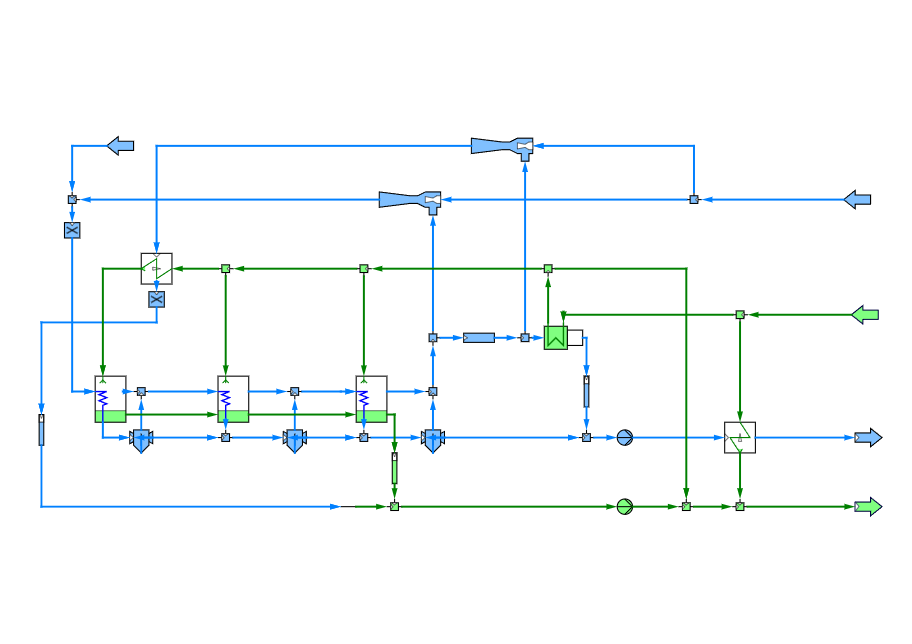
MED Plant with Mechanical Vapor Compression (MVC). MVC desalination is a thermal process in which seawater is evaporated and the generated vapor is mechanically compressed. When the vapor condenses, it releases heat that drives further evaporation. The condensate is collected as distillate, and the remaining liquid is discharged as concentrated brine.
MED Plant with Thermal Vapor Compression (TVC)
MED Plant with Thermal Vapor Compression (TVC). TVC desalination is a thermal process in which seawater is evaporated and the generated vapor is compressed by steam injection. When the vapor condenses, it releases heat that drives further evaporation. The condensate is collected as distillate, and the remaining liquid is discharged as concentrated brine.
Performance Models
To ensure affordable water supply through desalination, efficient and economical plant design is essential. Reliable performance models help engineers evaluate concepts, improve efficiency, and optimize operation. IPSE provides the tools needed to develop these models and apply them throughout the project lifecycle.